
KOICA-KDS Successfully Conclude 1st Korea Training for Nepal Project
Date 2026.05.21
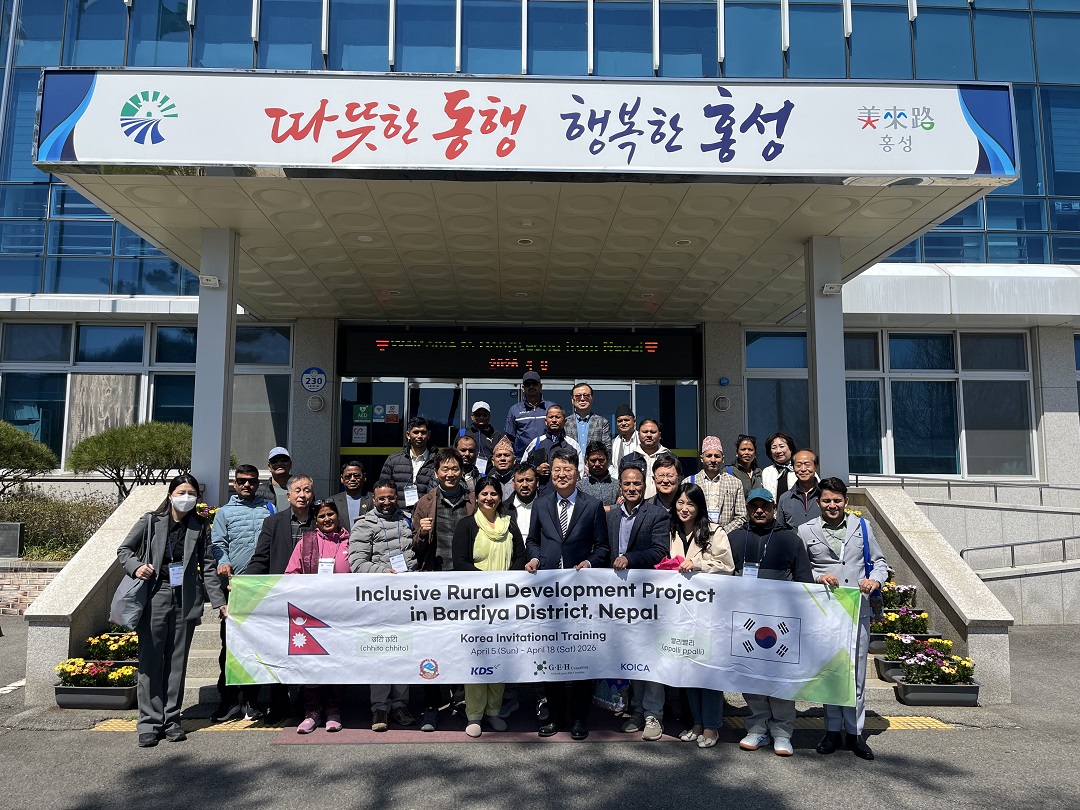
The Korea Institute for Development Strategy (KDS) hosted an invitational training program in Korea for Nepali project stakeholders for a total of 14 days, from April 5 to 18. This program was conducted as part of the ‘Project for Inclusive Rural Community Development in Bardiya District, Nepal (2024-2029 / USD 8 million),’ which is currently being implemented as a grant aid project by the Korea International Cooperation Agency (KOICA).
A total of 21 participants attended this training, including officials from the Federal Ministry of Nepal, local governments in the Bardiya district, cooperatives, and local PMC staff. The training was designed to share Korea’s experiences in rural development policy, agricultural technology, agricultural value chains, agricultural product marketing, and eco-cultural tourism. Based on this, the program aimed to strengthen agricultural and eco-tourism capacities in the Bardiya region of Nepal and to establish an effective foundation for implementing the project.
The training curriculum consisted of five core modules: ▲ Korea’s Rural Development Policy, ▲ Korea’s Agricultural Technology, ▲ Agricultural Value Chain and Agricultural Product Marketing, ▲ Eco-tourism, and ▲ Action Plan Formulation. It was conducted over a total of 67 hours through lectures, case studies, discussions, and field visits. The trainees learned about Korea's rural development policies and systems, smart agricultural technology, livestock manure treatment and resource utilization systems, the integration of agro-food processing, distribution, and sales, local food operation systems, eco-cultural tourism management cases, and methods for formulating Action Plans.
The field visits were divided into the sectors of agriculture/rural development and eco-cultural tourism. In the agriculture/rural development sector, trainees visited the Hwaseong AgriUni Smart Farm Airdome, Hwaseong Dawon Solution Livestock Manure Treatment Facility, Hongseong-gun Agricultural Technology Center, Gochang Maeil Dairies Sangha Factory, Wanju National Institute of Horticultural and Herbal Science / National Institute of Animal Science, and Wanju Local Food Direct Retail Store. Through these visits, trainees observed actual operational cases of the agricultural value chain, ranging from the agricultural production base to consumer linkage, including the application and dissemination of advanced agricultural technologies, livestock manure resource utilization, agro-food processing-distribution-sales linkage, and local food operations.
In the eco-cultural tourism sector, they visited "Hwaseong Yunggeolleung", "Suwon Hwaseong", "Yedangho", "Sudeoksa", "Haemieupseong", "Gochang Sangha Farm", "Jeonju Gaeksagil", and the "Seoul Botanical Garden". The trainees identified the potential for structuring tourism content using historical, cultural, and natural resources, developing tourism resources that reflect regional characteristics, and linking eco-cultural tourism with the local economy. From these, they derived applicable implications for the Bardiya region of Nepal.
Lee Young-ho, the Project Manager overseeing the project, stated, “This invitational training was a meaningful process to share Korea’s rural development policies, agricultural technology, agricultural value chains, agricultural product marketing, and eco-cultural tourism cases with Nepali stakeholders, and to collectively seek actionable solutions applicable to the Bardiya region.” He added, “We expect that the business plans and the collaborative networks among related organizations developed through this training will contribute to strengthening field execution capabilities and establishing an inclusive rural development model for this project.”
Nita Pokhrel Aryal, Joint Secretary of the Ministry of Federal Affairs and General Administration (MoFAGA) of Nepal, remarked, “This training was a meaningful opportunity to flesh out the implementation direction of the Inclusive Rural Development Project in the Bardiya region of Nepal and to explore ways to strengthen capacities in the sectors of agriculture and eco-tourism.” She continued, “Based on the key achievements and application strategies gained from this invitational training in Korea, we will strive to increase residents' income by improving agricultural productivity, strengthening market competitiveness, and revitalizing eco-tourism in the Bardiya region of Nepal.”
She further added, “I would like to express my deepest gratitude to KOICA, the KDS consortium, and the officials of the partner organizations who prepared this training. I hope this training serves as an opportunity to further strengthen cooperation between Korea and Nepal in the fields of agriculture and eco-tourism, leading to concrete cooperative achievements for sustainable rural development.”
LINK : https://www.kdpress.co.kr/news/articleView.html?idxno=205436
